Modern industrial software platforms can do considerably more than display process values. Applications built with Ignition can communicate with PLCs, execute scripts, manage production workflows, query databases, and exchange information with enterprise systems.
That flexibility is useful, but it also introduces an important architectural question: just because a supervisory application can perform a task, does that mean it should?
Different Systems, Different Responsibilities
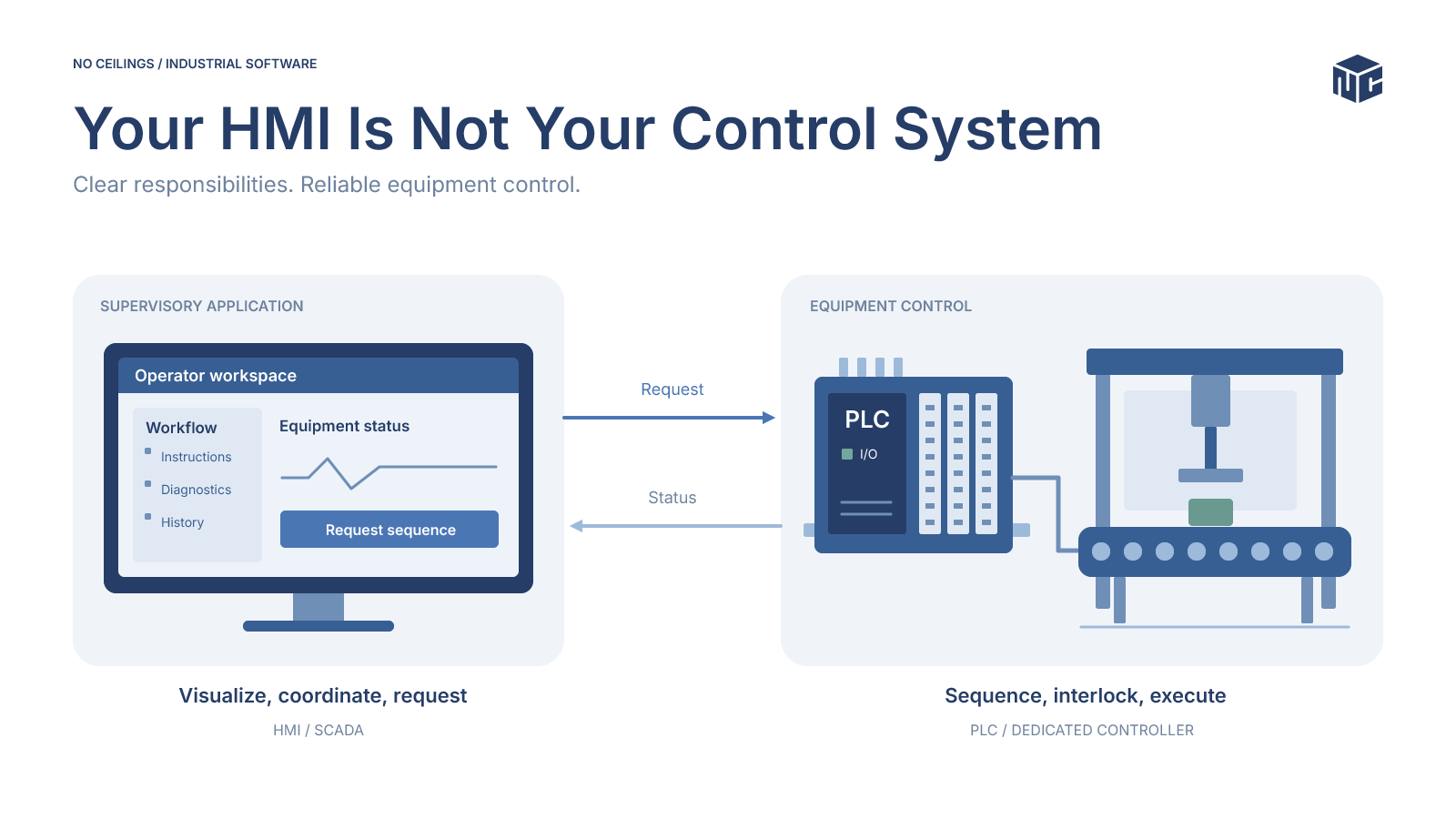
Industrial applications generally involve several layers of responsibility. PLCs and dedicated controllers handle equipment operation, while supervisory software provides visualization, coordination, data collection, and interaction with operators and external systems.
These responsibilities frequently overlap at their interfaces, but they should not become interchangeable without considering the consequences.
| Responsibility | Typical Owner |
|---|---|
| Equipment sequencing and interlocks | PLC or dedicated controller |
| Safety-related functions | Appropriate safety-rated control system |
| Operator visualization and commands | HMI or SCADA |
| Production instructions and workflow coordination | Supervisory application or MES |
| Historical data and reporting | SCADA, historian, or enterprise application |
These are typical boundaries rather than universal rules. The appropriate allocation depends on the equipment, performance requirements, and system architecture.
The Problem with Moving Control Logic Upward
Consider an operator interface that initiates an equipment sequence. The HMI may request that the sequence begin, but the controller should determine whether the equipment is in an acceptable state to execute it.
If the HMI becomes responsible for enforcing critical equipment conditions, the design may introduce dependencies on gateway availability, network communication, and application execution timing.
Those dependencies are not necessarily appropriate for deterministic control or safety-related functions. A browser session disconnecting or a supervisory service restarting should not leave equipment dependent on that application to maintain a safe operating state.
Supervisory Software Still Has an Important Role
Keeping equipment control in the appropriate controller does not mean reducing the HMI to a collection of buttons and indicators.
Supervisory applications can manage operator instructions, coordinate production transactions, present diagnostics, record process information, and provide interfaces for authorized commands. These functions benefit from the flexibility of software platforms without requiring them to assume responsibility for low-level equipment control.
For example, an assembly application may determine which instruction an operator should follow based on the product and work order. A PLC or tool controller can independently determine whether the physical operation has completed successfully. The supervisory application then uses that feedback to advance the workflow.
Design Around Clear Boundaries
At No Ceilings, we believe good industrial software architecture starts with understanding which system should own each responsibility.
Ignition is an excellent platform for visualization, integration, and supervisory applications. Its flexibility is one of its greatest strengths, but that flexibility should be applied deliberately.
The goal is not to make one application responsible for everything. It is to make the complete system work reliably, with each component performing the tasks it is best suited to handle.
For a practical example of this separation, see our Guided-Cart Assembly Line case study.