Industrial software is often expected to remain in service for years. During that time, equipment changes, production requirements evolve, new data sources are introduced, and different engineers may become responsible for maintaining the application.
An application can work perfectly when commissioned and still be difficult to maintain. The difference often comes down to decisions made during its initial development.
Working Code Is Only the Starting Point
Consider two Ignition applications that provide identical functionality. Both display equipment status, allow operator interaction, and record production information.
In one application, tag paths are repeated throughout views, scripts contain equipment-specific logic, and similar screens are maintained independently. In the other, shared behavior is consolidated, equipment references are parameterized, and application responsibilities are clearly organized.
Both applications may perform equally well today. The difference becomes apparent when a new production line is added or an existing workflow needs to change.
Maintainability is largely about reducing the effort and risk associated with future changes.
Reuse Without Unnecessary Complexity
Reusable views, parameterized components, shared scripts, and consistent data structures can significantly reduce duplicated development effort.
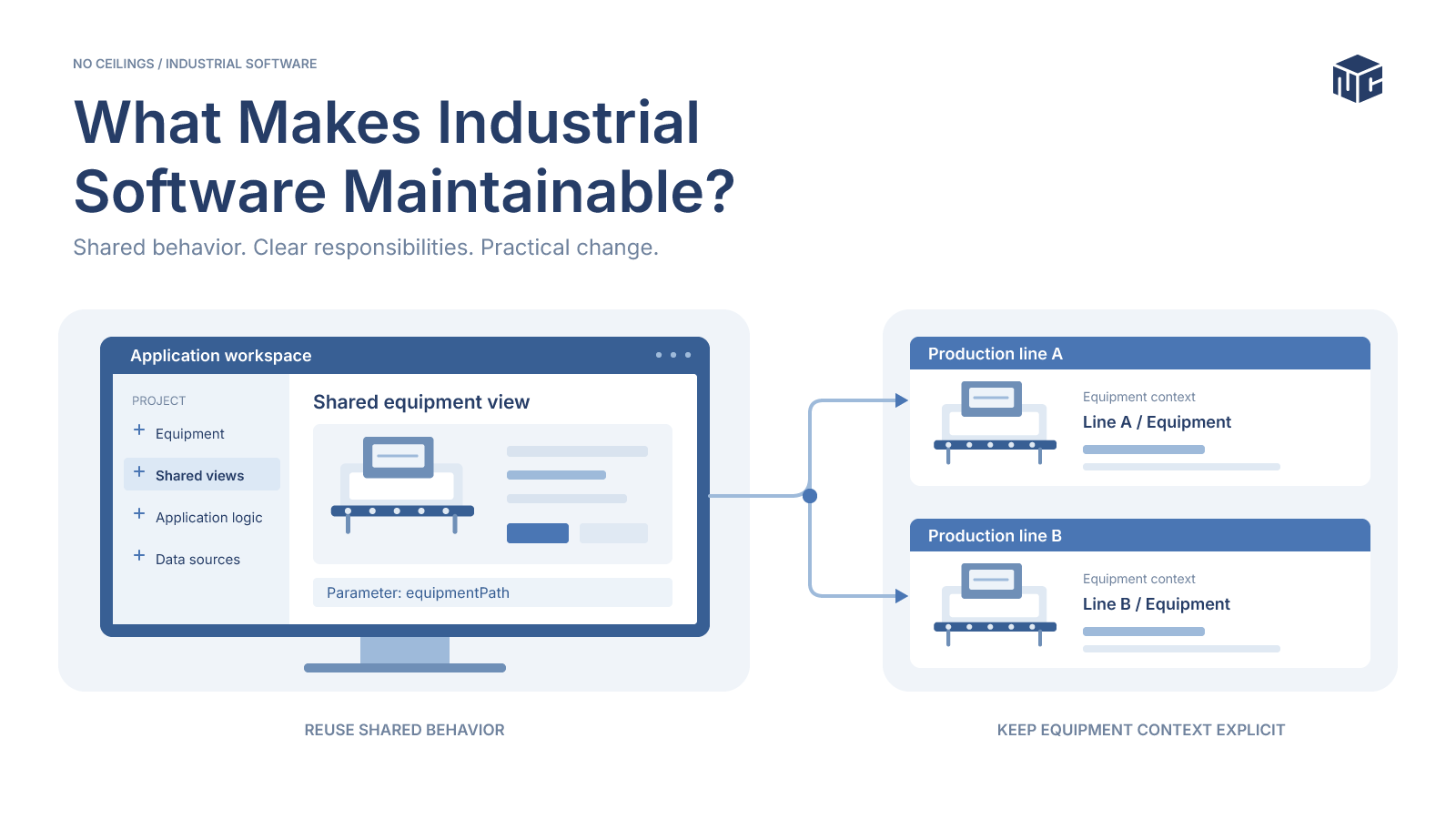
In Ignition Perspective, for example, a single parameterized view can represent multiple pieces of similar equipment. Rather than maintaining separate implementations, the application supplies the appropriate equipment context to the shared view.
However, reuse should not become an objective in itself. Excessive abstraction can make relatively simple applications difficult to understand. A generalized component with dozens of configuration options may be harder to maintain than two straightforward implementations.
The objective is to reuse behavior where it is genuinely shared, while allowing meaningful differences to remain explicit.
Organization Matters as Much as Functionality
Clear naming conventions, predictable project structures, and well-defined responsibilities make an application easier to navigate.
A developer investigating an equipment issue should be able to identify where the relevant data originates, how it is transformed, and which application components consume it.
When logic is distributed across unrelated event scripts, bindings, and gateway resources without a consistent structure, troubleshooting becomes unnecessarily difficult.
Separating data acquisition, application logic, and presentation does not require an elaborate software framework. Even relatively small projects benefit from clearly defined responsibilities.
Changes Should Be Controlled and Understandable
Maintainability also depends on how changes are introduced and verified.
- Version control: Maintain a history of changes to source code and exportable project resources.
- Development environments: Validate modifications before introducing them into production.
- Testing: Verify expected behavior, including relevant error conditions and equipment interactions.
- Documentation: Record important dependencies, configuration requirements, and non-obvious design decisions.
- Deployment practices: Establish a repeatable process for applying changes and recovering from unsuccessful releases.
Industrial platforms do not always support conventional software development workflows in exactly the same way as standalone applications. Their deployment models, project resources, and runtime dependencies may require additional consideration.
That does not eliminate the value of established software engineering practices. It means those practices should be adapted to the industrial environment.
Design for the Next Engineer
One of the most useful ways to evaluate maintainability is to consider what happens when the original developer is no longer available.
Can another engineer understand the project structure? Can they locate the logic responsible for a particular operation? Can they make a targeted change without unexpectedly affecting unrelated equipment?
These questions are just as important as whether the application meets its immediate functional requirements.
Maintainability Is an Engineering Decision
At No Ceilings, we view maintainability as part of application design rather than something to address after a system becomes difficult to modify.
Not every project needs an extensive framework, a complicated deployment pipeline, or multiple layers of abstraction. The appropriate level of structure depends on the size, complexity, and expected life of the application.
Good industrial software should not only work today. It should remain understandable and practical to modify as the systems around it change.
For examples of reusable components and structured application development, explore our Workspace Explorer and InteractionDetails projects.