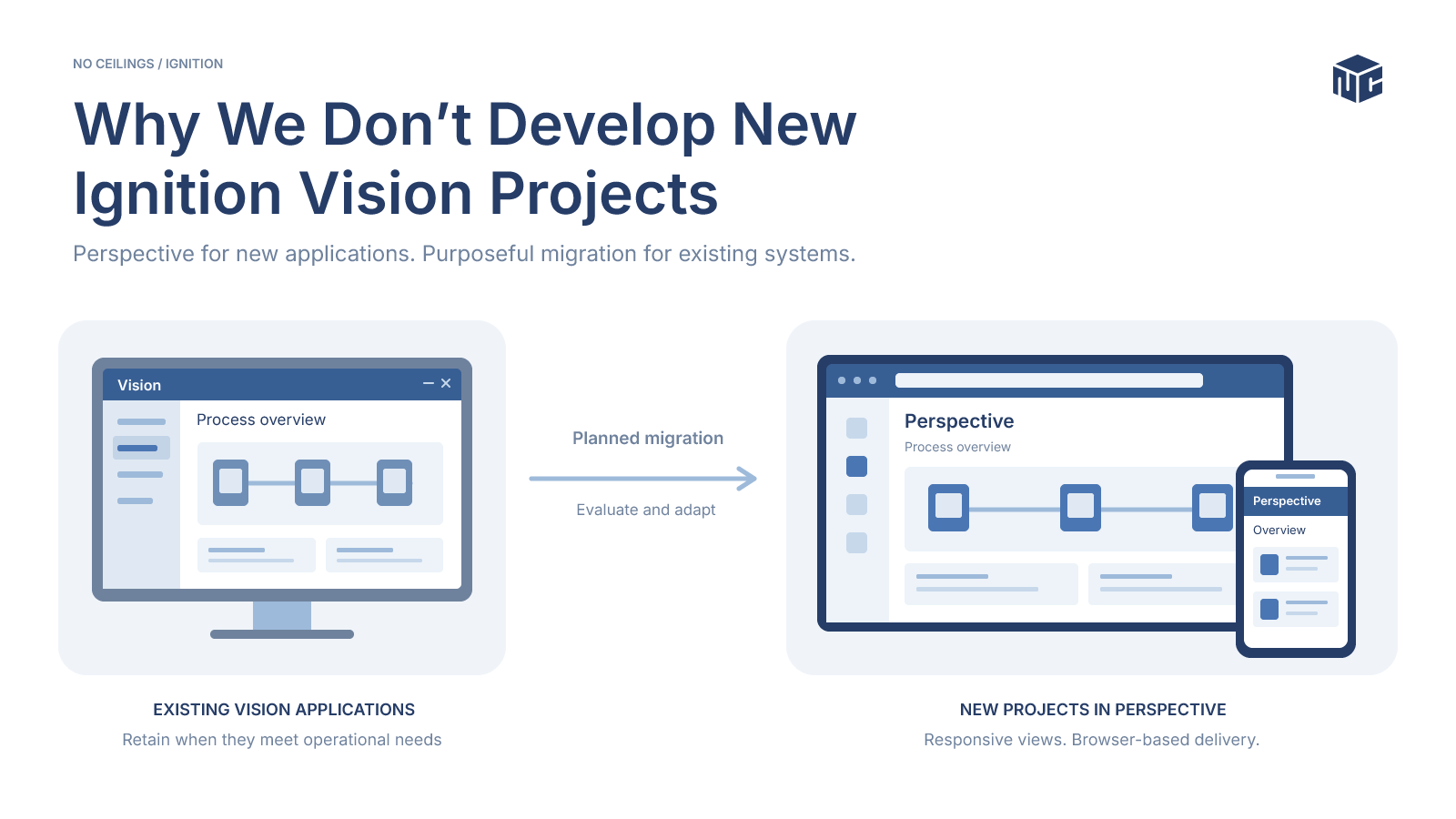
Ignition offers two established visualization modules: Vision and Perspective. Both are capable of building industrial HMI and SCADA applications, but they take fundamentally different approaches to development and deployment.
At No Ceilings, we’ve made a deliberate decision to use Ignition Perspective for all new visualization projects. We don’t take on new Vision development, but we do work with organizations looking to migrate their existing Vision applications to Perspective.
Why We’ve Standardized on Perspective
Vision is built around Java Swing and a desktop client model. Perspective uses modern web technologies, with interfaces delivered through a browser or dedicated Perspective application.
For the applications we develop, Perspective is a better fit for how we want to build and maintain industrial software. Its responsive layouts, CSS-based styling, reusable views, and browser-based deployment provide a flexible foundation for both operator interfaces and larger supervisory applications.
Just as importantly, standardizing on one visualization platform lets us focus our development practices, tooling, and reusable components on a consistent architecture rather than maintaining two separate approaches.
Vision Still Has Its Advantages
Our preference for Perspective doesn’t mean Vision is obsolete or technically inferior in every situation.
Vision’s desktop architecture allows scripts and certain interactions to execute directly within the client. Perspective, by comparison, executes its Python scripts on the Gateway, which introduces network communication for scripted interactions. Depending on the application and network conditions, that difference can matter.
Vision also provides capabilities that are particularly useful for desktop-centric applications requiring direct access to local operating system resources or specialized Java integrations.
Those are legitimate architectural advantages. They simply don’t outweigh the benefits of Perspective for the types of projects we choose to develop.
What About Existing Vision Applications?
There is an important distinction between choosing a platform for new development and deciding what to do with an existing system.
A stable Vision application that meets operational requirements doesn’t automatically need to be replaced. Migration introduces cost, testing requirements, and potential operational disruption. There should be a practical reason to undertake that work.
However, when an organization wants to modernize its interfaces, improve accessibility across devices, or consolidate development around Perspective, we can help plan and implement that transition.
Vision-to-Perspective migration isn’t a direct conversion of windows into views. The platforms differ in layout, navigation, component behavior, and scripting scope. A successful migration involves evaluating the existing application and adapting its functionality to Perspective’s architecture rather than simply reproducing the old interface.
A Deliberate Direction
We don’t believe every existing Vision project needs to be rewritten, and we recognize that Vision remains a valid choice for certain industrial applications.
For our own development work, though, the direction is straightforward: new applications are built in Perspective, and existing Vision applications are considered for migration when there’s a clear reason to make the change.