- Connecting Manufacturing and Enterprise Systems
- Integrating ERP, MES, and Industrial Automation
- Industrial Connectivity with Ignition, Kepware, and OPC UA
- Application Interfaces, APIs, and Middleware
- Designing Reliable Data Exchange
- Our Software Integration Process
- Integration Built Around Your Existing Infrastructure
- Ready to Connect Your Systems?
At No Ceilings, we develop system integration solutions that connect industrial automation systems, manufacturing applications, and enterprise business platforms. By enabling reliable data exchange between different technologies, we help organizations coordinate production activities, improve information accuracy, and reduce manual processes between disconnected systems.
Whether you’re integrating a Manufacturing Execution System (MES) with production equipment, using Ignition to connect equipment and manufacturing applications, integrating SAP or another Enterprise Resource Planning (ERP) platform with production operations, or developing custom interfaces between existing applications, we design solutions around your infrastructure, operational requirements, and business processes.
Connecting Manufacturing and Enterprise Systems
Modern manufacturing environments depend on multiple software platforms, each serving a different operational purpose. Industrial control systems manage equipment and processes, manufacturing applications coordinate production activities, and enterprise systems support planning, inventory, procurement, and business operations.
Although these systems often depend on the same information, they may use different communication protocols, data structures, and application interfaces.
Our software integration capabilities include:
- Manufacturing Execution Systems (MES/MOM): Integrating manufacturing applications, including Siemens manufacturing operations platforms, with production equipment, operational databases, and enterprise systems.
- Enterprise Resource Planning (ERP): Connecting SAP and other ERP platforms with manufacturing applications to exchange production orders, material information, inventory transactions, and production results.
- Industrial Connectivity Platforms: Configuring and integrating software such as Kepware Server to establish communication between industrial equipment and applications.
- Ignition Integration: Using Inductive Automation Ignition to collect industrial data, develop application interfaces, and exchange information with databases, MES/MOM platforms, and enterprise systems through supported connectivity methods.
- SCADA and Automation Systems: Connecting supervisory applications, historians, PLCs, and industrial control systems with manufacturing and enterprise software.
- Database and Application Integration: Developing interfaces between SQL databases, business applications, and operational systems.
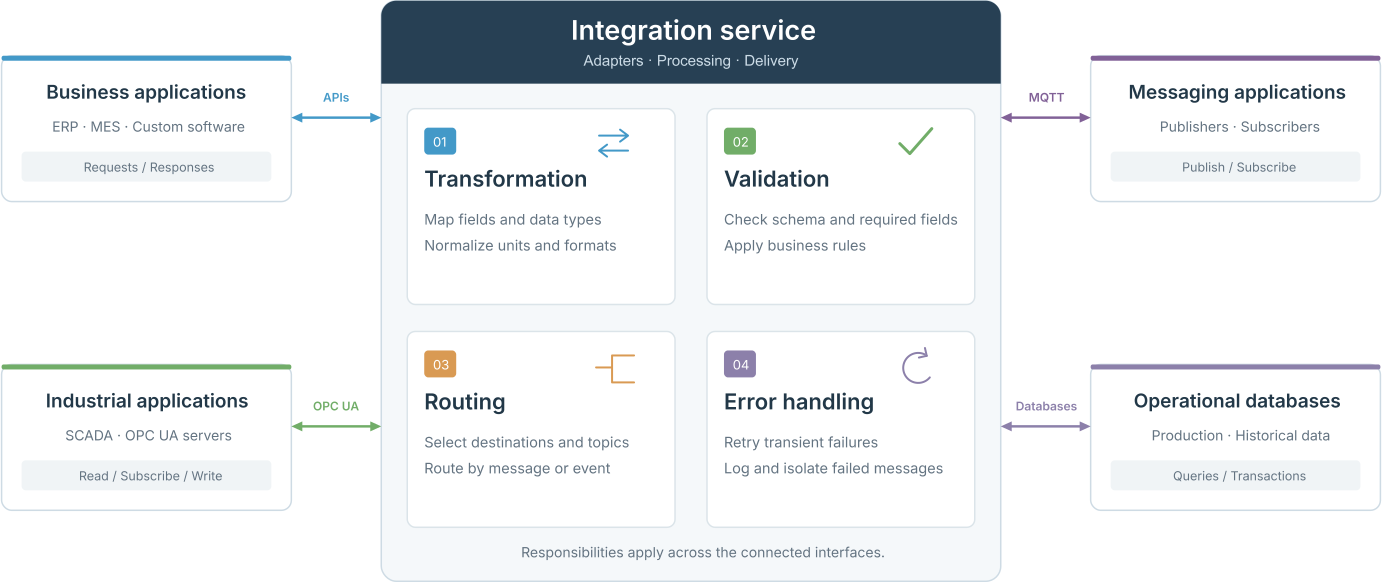
- Custom Middleware: Building software components that transform, validate, route, and coordinate information between systems without compatible native interfaces.
Our objective is to establish well-defined communication between applications while preserving the responsibilities and operational requirements of each system.
Integrating ERP, MES, and Industrial Automation
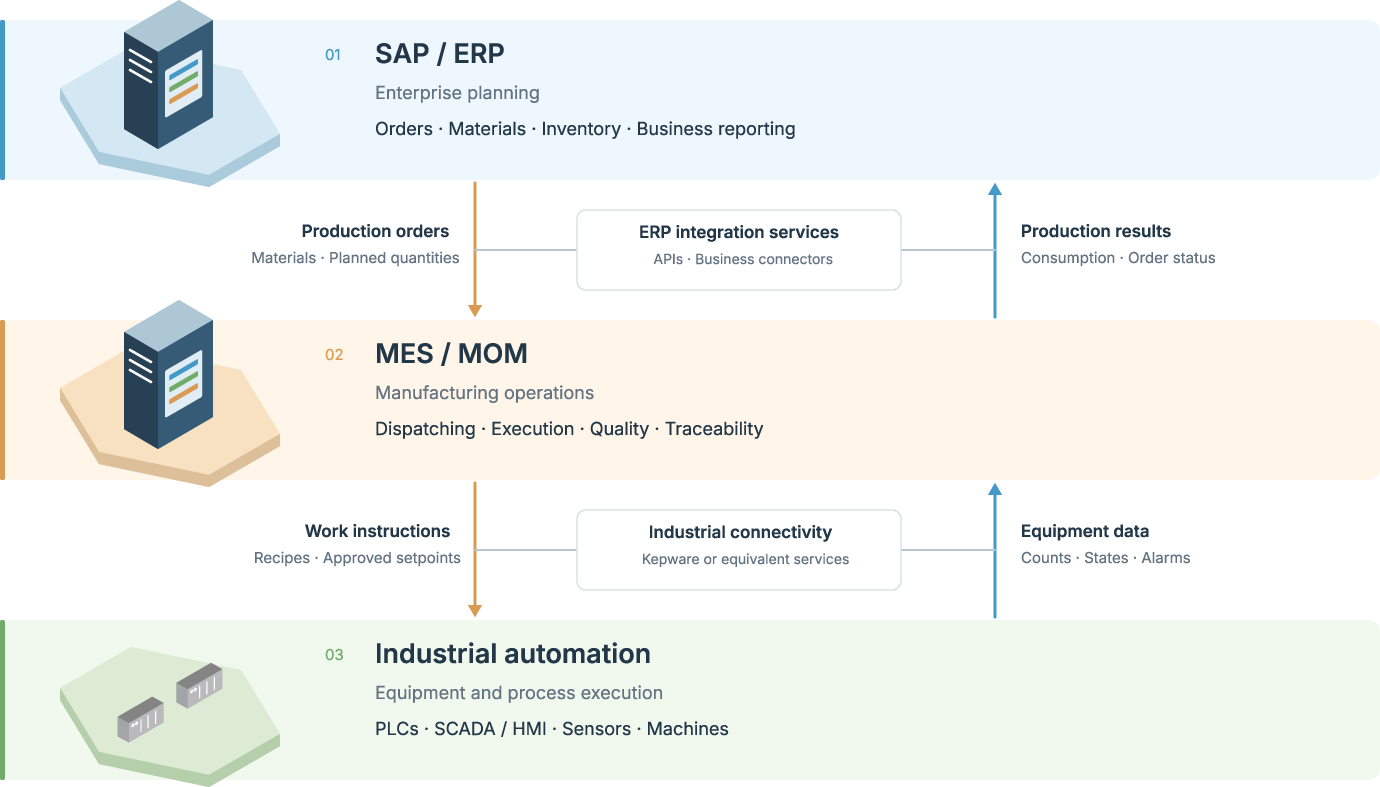
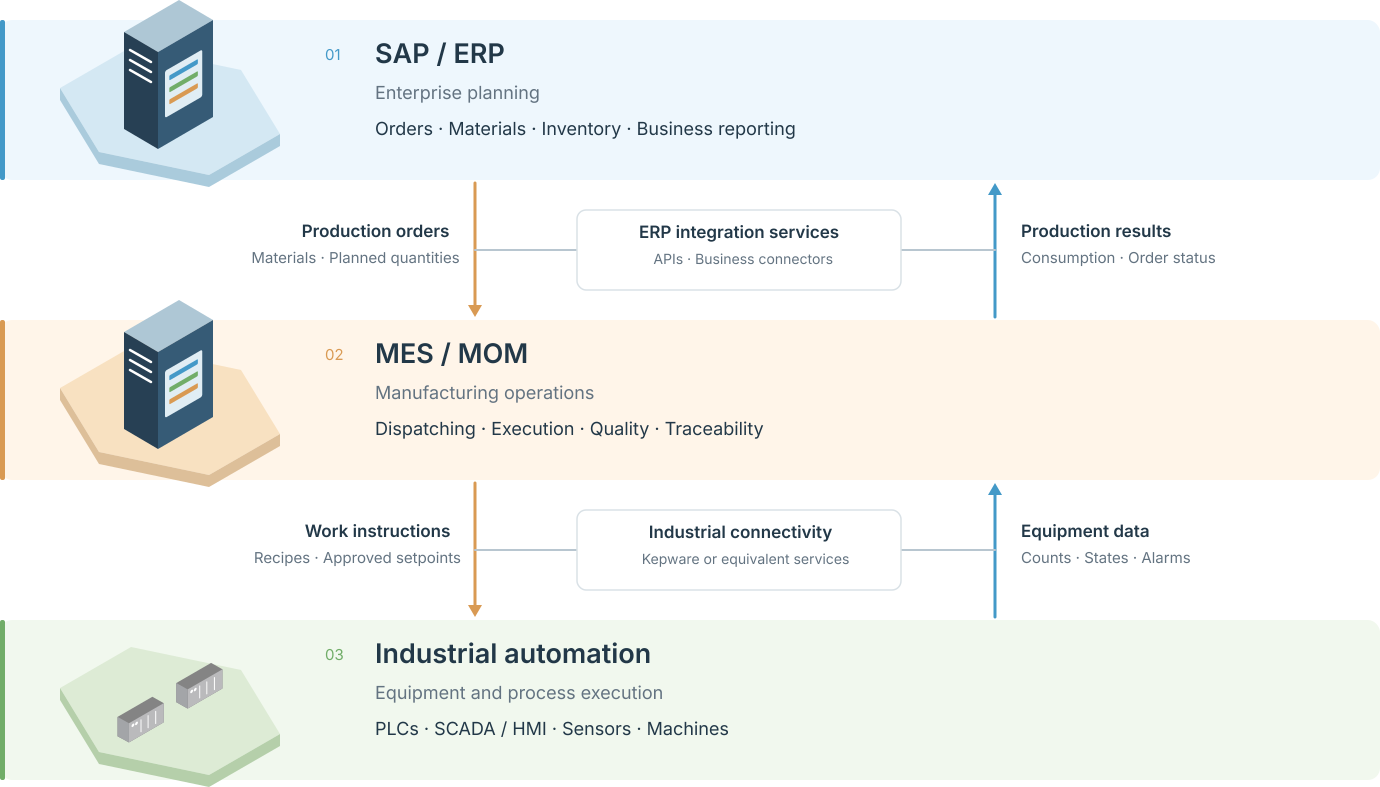
One of the most common manufacturing integration requirements is connecting enterprise planning systems with the applications and equipment responsible for executing production.
An ERP platform may manage production orders, inventory, and material requirements, while an MES coordinates production execution and records manufacturing activity. Industrial automation systems provide the equipment status, process values, and production events needed to support those activities.
Integrating these systems allows information to move between business operations and the production environment.
ERP, MES and Industrial automation
Interfaces and permitted write operations are defined for each system and applicationProduction Orders and Scheduling
Production orders created in an ERP system can be transferred to manufacturing applications, where they become available for scheduling, execution, and tracking.
Depending on the application architecture, integration may include order identifiers, product information, quantities, material requirements, and production priorities.
Equipment and Production Data Collection
Manufacturing applications can receive equipment data through industrial connectivity platforms such as Kepware, Ignition applications, SCADA systems, databases, or supported application interfaces.
This information may include machine status, production counts, process measurements, alarms, and other events relevant to manufacturing execution.
Production Reporting and Inventory Transactions
As production progresses, manufacturing systems can communicate completed quantities, material consumption, scrap information, and production results back to ERP applications.
These exchanges help keep enterprise records aligned with actual manufacturing activity while reducing duplicate data entry and manual reconciliation.
The specific information exchanged, transaction direction, and timing depend on the systems involved and the operational workflows being supported.
Industrial Connectivity with Ignition, Kepware, and OPC UA
Industrial software integration often begins with establishing reliable access to equipment data.
PLCs, drives, sensors, and other automation devices may communicate using protocols that are not directly supported by manufacturing or enterprise applications.
Industrial connectivity platforms such as Kepware Server can provide a communication layer between supported industrial devices and higher-level applications.
For example, equipment data collected through Kepware may be exposed through OPC UA to an MES, SCADA platform, or another compatible application.
We develop integration architectures that consider device connectivity, tag organization, data types, update requirements, communication reliability, and the needs of consuming applications.
Where appropriate, these architectures can incorporate additional software services to transform equipment information into data structures suitable for manufacturing applications.
Ignition as an Integration Platform
Ignition by Inductive Automation can serve as an integration platform between industrial equipment, operational databases, manufacturing applications, and enterprise services. Its Gateway provides a central runtime for industrial connectivity and application services, while scripting and database capabilities support integration workflows tailored to the facility.
For example, an Ignition application can collect production counts and equipment status from PLCs, associate that data with production context, and make the resulting information available to an MES or another system through an agreed interface. It can also consume information from external applications when their supported interfaces and security requirements allow it.
We consider Ignition for integrations involving OPC UA, SQL databases, scripting, and application-level data exchange. Connections to SAP, MES platforms, or other enterprise systems require an appropriate API, database interface, middleware service, or supported third-party module; they should not be assumed to be native integrations.
Application Interfaces, APIs, and Middleware
Not every application provides a direct connector to the systems it needs to communicate with.
Manufacturing environments frequently contain a combination of modern platforms, legacy applications, proprietary data formats, and specialized software developed for individual production processes.
In these situations, custom interfaces and middleware can provide the communication layer needed to connect otherwise incompatible systems.
Application interfaces and middleware
Available operations depend on each connected system and adapterOur integration solutions may incorporate:
- REST APIs: Exchanging information through application interfaces for retrieving, creating, or updating records.
- OPC UA: Accessing industrial equipment and process data through standardized interfaces.
- MQTT: Distributing operational information through publish/subscribe messaging architectures.
- SQL Databases: Reading, writing, and coordinating structured data between applications, including database-backed workflows developed in Ignition.
- Data Transformation: Converting values, identifiers, units, and data structures into formats required by receiving systems.
- Transaction and Error Handling: Validating information, recording integration activity, and managing failed or incomplete exchanges.
The appropriate technology depends on the interfaces supported by each application, the sensitivity of the information, network requirements, and whether the integration involves real-time data, scheduled synchronization, or event-driven transactions.
Designing Reliable Data Exchange
Establishing connectivity is only one part of a successful software integration.
A reliable solution must also account for how applications behave when information is missing, communication is interrupted, or a receiving system cannot process a transaction.
For manufacturing and enterprise integrations, these considerations can be especially important because incomplete or duplicated information may affect production records, material tracking, or inventory accuracy.
We consider several factors during integration design:
- Data Mapping: Defining how identifiers, values, and records correspond between systems.
- Validation: Checking required fields, formats, and business rules before processing information.
- Transaction Management: Establishing acknowledgment, retry, and duplicate-handling behavior where supported and appropriate.
- Error Reporting: Providing useful diagnostic information when communication or processing fails.
- Security: Accounting for authentication, authorization, network segmentation, and permitted communication paths.
- Maintainability: Documenting interfaces and system dependencies to simplify troubleshooting and future changes.
These considerations help establish predictable behavior between applications without introducing unnecessary dependencies into critical manufacturing processes.
Our Software Integration Process
Every integration project begins with understanding the applications involved and the operational processes they support.
1. Requirements and System Assessment
We work with engineering, operations, IT, and application stakeholders to identify the systems that need to communicate, the information being exchanged, and the expected operational behavior. This includes reviewing existing interfaces, documentation, data structures, and relevant network or security requirements.
2. Integration Architecture and Data Mapping
We define the integration architecture, including communication methods, application responsibilities, data mappings, transaction flows, and error-handling requirements. Where multiple integration approaches are available, we evaluate their suitability for the existing environment.
3. Development and Configuration
We configure industrial connectivity platforms, develop Ignition-based integration logic and application interfaces where appropriate, or implement custom middleware according to the agreed architecture. This may involve API integrations, database operations, industrial communication interfaces, and supporting software services.
4. Testing and Validation
We test the integration against defined requirements, including data accuracy, expected transaction behavior, communication failures, and application responses. Where practical, testing includes representative production workflows and coordination with the teams responsible for each connected system.
5. Deployment and Documentation
We coordinate deployment with the appropriate stakeholders and provide documentation describing the integration architecture, interfaces, configuration, and operational dependencies. The goal is to deliver an integration that can be understood, maintained, and extended as the connected systems evolve.
Integration Built Around Your Existing Infrastructure
Manufacturing environments rarely consist of applications from a single vendor. A facility may operate established MES software, modern ERP applications, industrial connectivity platforms, custom databases, and automation equipment installed over many years.
Replacing these systems is not always practical or necessary.
At No Ceilings, we focus on connecting existing technologies through appropriate interfaces and maintainable integration architectures. Our experience across industrial automation and IT/OT environments allows us to consider both the software requirements and the operational infrastructure supporting them.
Whether the requirement involves a single application interface or data exchange across multiple manufacturing and enterprise platforms, we approach each integration with an emphasis on reliability, technical clarity, and long-term maintainability.
Ready to Connect Your Systems?
Whether you’re implementing a new MES platform, integrating SAP with manufacturing operations, connecting equipment through Ignition or Kepware, or developing an interface between existing applications, No Ceilings can help evaluate your requirements and develop an appropriate integration solution.
Request a quote to discuss your software integration project.